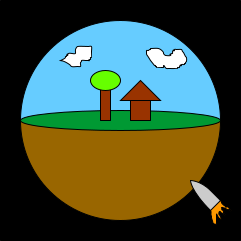
Interpretation of "the earth is round": The surface of the earth is round like a coin (i.e., flat), but the ground in the middle is thicker below the surface (making half a sphere), and the sky is like a dome, making the whole ground-sky combination a sphere. I remember wondering how rocket ships made sure to enter the earth on the right side (the sky, not the ground), since I knew there was no "up" in space.
The international date line causes time travel. If you can stand on one side of it and it's the previous day on the other side, then you could go back in time by going around the world fast enough and crossing it multiple times per day. (When I asked my mom about it, she said something that, looking back, I now suspect is about faster-than-light travel, which didn't help to resolve this misconception.)
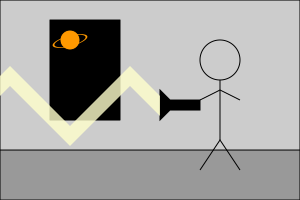
Rocket ships regularly have to avoid black holes. They can detect black holes by shining a flashlight in the ship; if they're near a black hole, the beam would have a zig-zag shape, since black holes bend light.
I don't remember for sure, but I think in general I sort of vaguely assumed that we had gotten farther in space travel, and more frequently, than we actually had. I probably wouldn't have been surprised if I'd heard we had achieved interstellar travel. (Also I didn't know we hadn't gotten detailed images of Pluto until not that long before we actually did get a detailed image.)
History and geography
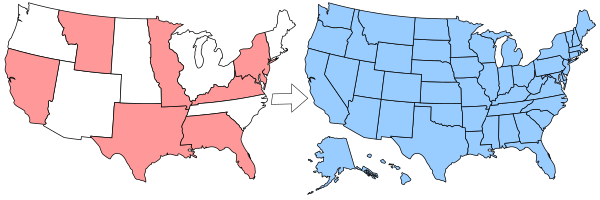
The United States of America started with 13 large colonies covering the entire modern-day US, which then split up into smaller states (like, say, maybe a Pacific Northwest colony split up into Washington, Oregon, and Idaho, or something; I didn't have any specific ideas of what the colonies were), rather than all the colonies being along the east coast and corresponding fairly closely to modern states. [image based on image from Wikimedia Commons; example of the sort of thing I thought, specifics chosen somewhat arbitrarily]
Once someone told me that people from Scotland were called Scots, and I thought they meant that everyone named Scott was from Scotland and everyone from Scotland was named Scott. I don't think I believed them, though.
European colonization of Africa happened earlier than colonization of America, since Europeans knew about Africa first, and I got the impression that Europeans colonized America right after they discovered it, so I assumed the same happened with Africa.
I've seen people talking about how in history classes in the US, the War of 1812 is taught as its own thing, whereas in the UK it's treated as a minor part of the Napoleonic Wars. For me, it's even more extreme: I didn't know until many years after the War of 1812 was taught (and I think also after I played a part in the 1812 Overture at music camp) that the Napoleonic Wars were even around the same time, and don't remember Napoleon being mentioned in any history class before college. (That said, history was never a subject I was good at; it's possible I was supposed to learn this and failed, or maybe I did learn this and then forgot and relearned it later.)
Words and phrases
"Filibuster" is a brand of vacuum cleaner. (It busts filth? Perhaps inspired by the "dust buster"?)
"Rolling one's eyes" meant moving one's pupils in a circular path (i.e., look up, then right, then down, then left, repeat several times; or that in reverse); not "looking up".
"10% unemployment rate" means that each year (or maybe some other time unit), 10% of the current workforce gets laid off (that is, it's a per-time-unit thing, and doesn't include people who can't find work to begin with or were laid off previously). Interpreted as (unemploy)ment, with unemploy as an action (rather than a state); from context I inferred that it was specifically laying off, rather than firing.
"Objects in the mirror are closer than they appear": aside from being generally confusing, I thought this meant that the objects appeared closer in the mirror than they do in real life (i.e., the objects in the mirror are closer than the real objects not in the mirror).
Definitely Disnep, not Gisney or Gisnep. (How do people get a "G" out of that, anyways?) I don't remember if I actually thought that's what the logo said, or just thought it looked like it said that (I knew the company was Disney).
The "K" in "401(k)" stands for "kilobytes"; it's in parentheses to indicate that it could also be just called a "401", with the "k" implied. (I saw the term in a context where I had no idea what sort of a thing it was; I think maybe I thought it was a type of modem, like 56K.)
"Money laundering" means counterfeiting.
The word "suck" to mean "is bad" (as in "that sucks" or "you suck" or whatever) comes from "sucking your thumb", and originated as a way to describe someone as babyish (and therefore immature).
"Manila" (in "manila envelope") is a mispronunciation of "vanilla" (referring to color, even though it's not the same color I'd normally associate with vanilla). (It didn't help that the first time I heard it, the person who said it was also pronouncing "envelope" in a way I thought was wrong.)
"Brought to you by" just refers to anyone who helped in some way with a thing, not specifically money. I seem to remember making something that had at least one of myself, my mom (as in, like, stuff one would put in an "acknowledgements" section), and/or the program I used to make it (uncertainty because it's been so long I can't remember, also it's possible this happened multiple times).
"Plus sizes" are sizes that are in between the regular sizes. That is, if a regular clothing store has sizes 9, 10, 11, etc., a store that advertises "plus sizes" would also have 9+ (between 9 and 10, i.e., 9½) and 10+ (between 10 and 11) (like how a grade of B+ is between an A and a B).
Sexuality
The only reason gay marriage was not allowed was that the people who originally made the law simply weren't aware that people would want it, or they just didn't think about it (i.e., it was an unintentional oversight). The only reason someone would not want to change the law to allow it was general resistance to changing laws; no one would be actively against it. The proposed constitutional amendment (at the time) regarding gay marriage was to allow it.
NSFW/Content warning: talks about private parts (text only, no images)
Each human couple only has sex ("whatever it is people do to have kids") only once (not once per child; just once). That one instance of having sex can result in pregnancy years later, and can result in multiple pregnancies; when and how many times is completely random. That is, once a woman has had sex once, she has the man's genetic material for the rest of her life and can get pregnant with his kid at any time after that until she's too old to have kids (even if she's divorced or widowed and hasn't been around him in years).
Penises aren't involved in sex, only testicles (which I confused with "intestines") are. (Sperm just sort of diffuses through the scrotum, probably.)
Vaginas look the same as buttholes; girls just have a line of three holes down there that look the same, one for babies, one for poop, and one for pee.
"Penis" is a gender-neutral word for wherever pee comes out of, and is derived from the word "pee".
Seventh grade sex ed: How do ketchup and mustard protect you from getting pregnant and getting STDs? Once I realized they were talking about something different, I imagined condoms as like a box that people put their penises into for some reason?
Other
Macintosh/Windows market share was roughly 50/50, with only slightly more Windows computers. (Probably because the main places I had access to computers—home and school—had Macs.)
Scissors and ripping/tearing apply tension force, not shear force. Also scissors removed a line of finite thickness between the two parts of the thing being cut (and I wondered where that went).
When you become an adult, you just somehow …know how to do adult stuff, like having a job and raising children and whatnot.
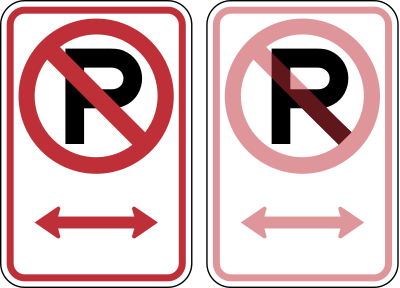
No-parking signs are actually a crossed-out R (the slash looked like the extra stroke on the R) [image is based on image from Wikipedia]
Sitcoms and soap operas are the same thing. I think I saw a bit of some soap opera and some sitcom, didn't understand what was going on, but noticed that they had similar settings and similar-looking characters (probably something like, adults roughly the same age in modern houses or apartments… given that I would have been used to shows featuring kids, talking animals, sciencey stuff, probably some fantasy or sci-fi settings, etc., adults in houses at least wouldn't be the default).