This is a list of random questions that I felt like answering, and answers to those questions. Aside from this top section, all of them are questions which I have at some point in my life been asked in some form in some context, or which I've seen asked to the general public in some form (though some may have been paraphrased).
This used to be at the bottom of my about me page, but I decided to add more questions, so I made it its own page.
Alive, relatively healthy, not sure where my life is going.
Demon, dragon, or hamster?
Hamster
What's your favorite breakfast food?
Probably some waffle, with fruit and/or syrup. And a side of bacon.
Overall, what I generally prefer for breakfast and what I think of as breakfast foods tend to be bread-ish things (waffles, pancakes, French toast, bagels, pastries, etc.), rather than eggs, meats, or potatoes (although sometimes I get meat on the side, and I tend to like breakfast sandwiches).
Do you prefer keys with sharps or flats?
For context: my understanding is that string players (and orchestras) prefer sharp keys, and wind players (and bands) prefer flat keys, but I started out with piano as a solo instrument. I then played pitched percussion (xylophone-like things, which have the same layout as piano) in middle school band, and piano in a high school orchestra. I also haven't played music much recently (so I'm kind of going by memory), and I was more interested in composing music than playing it, so I'm basing this a lot on what I'm inclined to compose in.
My default key if I were writing music or playing something by ear or from memory would be C major (no sharps, no flats), and I think overall I'd prefer keys with fewer sharps or flats (closer to C major in the circle of fifths) than keys with more sharps or flats.
If I were naming notes out of context, I think my inclination would be to call the black keys C♯, E♭, F♯, probably A♭, and B♭, which is consistent with notes used in keys close to C major. For white keys, definitely B rather than C♭, C rather than B♯, etc.; as a pianist, I'm used to sharp or flat = black key, which also contributes to my preference for closeness to C major.
On the other hand, if I were writing something in minor, I think my default choice of key could be either A minor or C minor, depending on random chance (so, either like C major in that there are no sharps or flats, or like C major in that the nth note of the scale is the letter I'm used to it being), so at least in minor, I'm okay with flat keys.
But I think in major I might be more inclined towards sharp keys? Thinking about it more, I think at least part of it is a preference towards keys that start with naturals; in major, F is the only key with flats that starts on a note that isn't flat, hence the preference for sharps there, whereas in minor there are plenty of keys that start with naturals but contain flats.
For the three major keys that have enharmonic equivalents (C♭/B, G♭/F♯, D♭/C♯), I think my preference would be sharps for all of them:
When I was starting piano lessons, my piano teacher started me on scales with lots of black keys (apparently someone thought this would help people not be scared of black keys), and I specifically remember learning B and F♯ (possibly the first two scales I learned?), so those feel more familiar to me.
For B specifically, it starting on a natural helps it (and C♭ not only starts on a flat, but on a flat that's a white key).
For C♯, my inclination is to think "Oh, that's easy, just make everything sharp" (although I'm not sure if I've played anything in C♯ or D♭, so I'm less confident about this). And that inclination doesn't apply to C♭ because the previous two points are stronger.
For minor… probably flats, just because A♯, D♯, and G♯ aren't major keys. But I'm not sure if I've played anything in any of those keys.
I think it's ambiguous, but at least the q and the second u are pronounced. The q is, of course, what makes the /k/ sound at the beginning. The vowel is a sound that u can make, but u after a q is usually not a vowel (it's generally either /w/, like in queen, or silent, like in queso or unique), so the second u being the vowel that's pronounced makes the most sense.
The ambiguity has to do with whether the word contains any digraphs. The combination qu could easily be interpreted as a digraph, in which case the first u isn't silent but rather part of the digraph that makes the /k/ sound. And either eu or ue could be interpreted as digraphs that make the vowel sound; of those, eu making the vowel sound probably makes more sense, since that would make the last e silent, which is common.
I don't know French (which is where the word comes from), but looking at Wikipedia's French orthography page and the French pronunciation of queue, it looks like in French, digraph qu, digraph eu, silent e would give the right pronunciation, which is consistent with my with-digraphs interpretation (although the English interpretation of a spelling doesn't necessarily have to match up with how it's interpreted in the language of origin).
Will you create a giant robot or an army of robots for me?
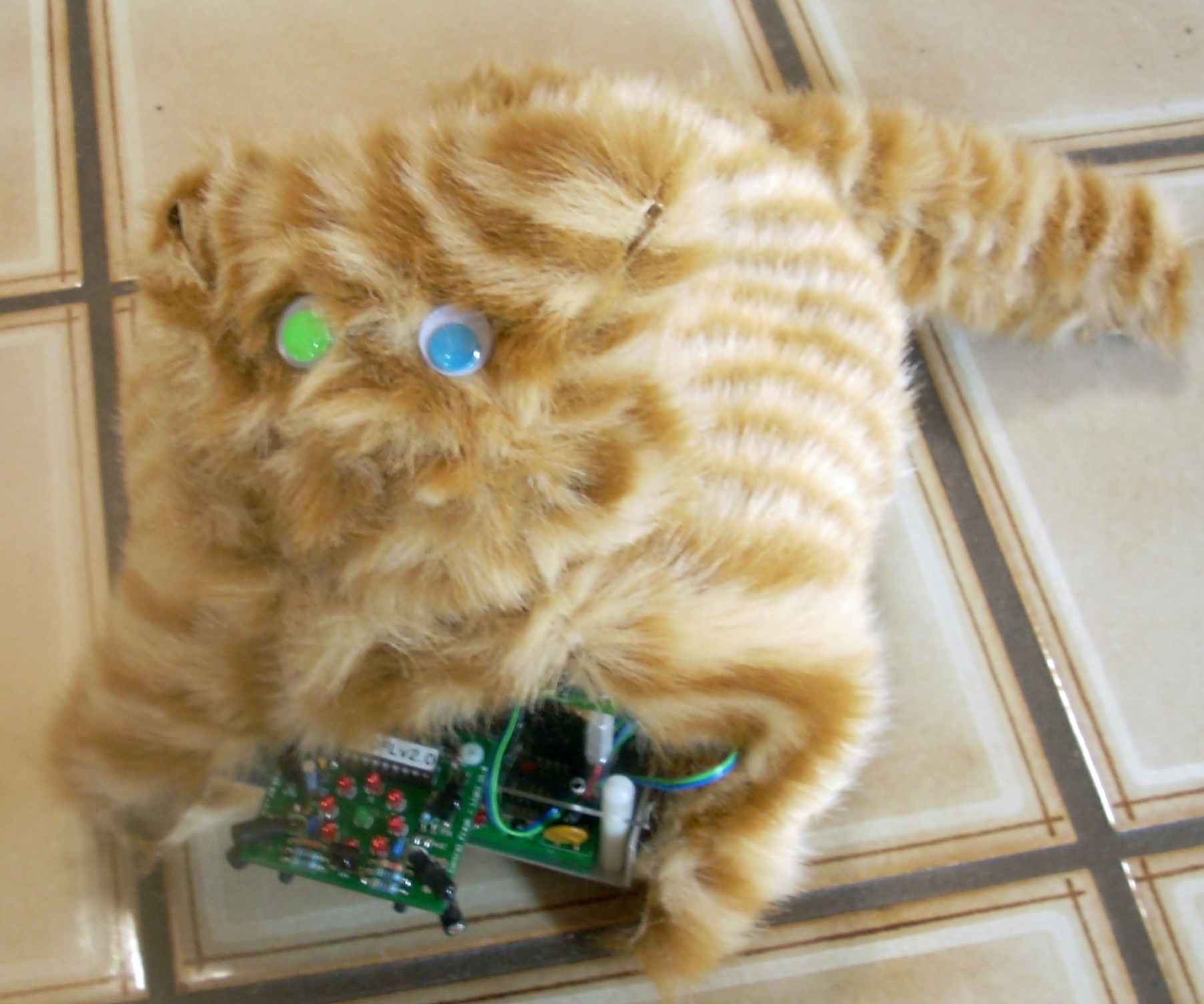
No. A giant robot would be too potentially destructive and an army of robots would be too actually destructive. Therefore, I shall make neither of those, and instead I shall take over the world with my CUTE LITTLE KITTY ROBOTS!!! *Meow*
(Note: I'll only allow robots I build to take over the world for myself; I'm not going to let you use them for your own evil plans. If you want to take over the world, then make your own robots.)
Can you teleport?
No. You just weren't paying attention when I walked over here.
Do you have a lighter/cigarettes?
No. I'd rather you didn't smoke at all, but if you want to smoke anyways, the least you can do is provide your own materials. And stand downwind from me.
(In practice I usually just say "no" or shake my head.)
Wait, are you left-handed?
I'm cross-dominant: I write (and draw, and use a fork) with my left hand and do almost everything else (e.g., using a computer mouse, throwing a ball, using scissors, using a knife) with my right hand.
(This means that I keep my fork in the same hand, not because I'm European, but because that happens to line up with my dominant hand. Also I don't really care about those sorts of arbitrary rules.)
Also, in high school I tried to learn to write with my right hand, just to see if I could. I was able to write fairly okay but still not as well as my left hand; I haven't done that in a while, and even then I still mainly used my left hand. (I also intentionally used different forms for a, t, and g when learning to write with my right hand. Sample.)
The only time I can think of where handedness has really caused me any issues was when I had a Palm PDA. Text input was done by writing letters with the stylus, and some characters (at least T, +, and -) involved a horizontal stroke, which for me is most natural to do right to left, but a right-to-left stroke means delete the previous character, so I kept accidentally deleting a character.
*spends a while counting on her fingers* 86, if you count the 3 at the beginning.
I memorized it in high school, a few digits at a time, and then haven't really tried memorizing more after that (but I still remember it!).
I remember it in groups of digits of varying length: 3.14159 26535, 8979 323, 846264-3383 2795-02, 884 197-169, 399-375-105, 820 974-944 59230-78164, 0628 6208 998 6280. Part of this is just kind of chance, but a lot of it is due to noticing certain patterns, especially the fact that there are a lot of three-digit palindromes near the beginning of pi; there's also a run of even digits with a five-digit palindrome, and three groups of four digits near each other that are anagrams of each other.
Would you rather have the power to become invisible or to fly?
Become invisible. As a shy person, this could be useful (sometimes I just want to disappear and not be seen by others). And in theory, I could also use the power invisibility to fly, by sneaking onto an airplane, giving the best of both worlds.
If you had just one minute to speak to everyone on Earth at the same time, what would you say?
I would either (a) have really bad stage fright and not think of anything to say for 55 seconds, then think of something really important to say that I really wanted to say and not have time (possibly that would happen a few days later), or (b) refer everyone to a page on my website (having thought of a), so I could put what I wanted there, but then forget to actually make the page (or remember to make the page but leave it with a "coming soon" message on it) until everyone has forgotten about me. I'm not sure which.
You see a turtle lying on his back, yet you don't flip him over. Why?
Because I'm too afraid of hurting him. His legs are probably fragile, and his insides as well, so if I tried to move him I might damage something.
What would your dying words be?
"Yes, I'm sure my artificial intelligence won't become sentient and evil."
If you worked at the SCP foundation, what would you do, and what unfortunate fate would you meet doing it?
I'd be one of the SCPs, not knowing where my anomalous properties come from, wishing I could just get away from there and live my life, living in fear that they'd consider me too dangerous or that my anomalous powers would turn against me.
To be more specific… perhaps a reality bender living in constant fear that one wrong thought could cause the whole universe to disappear.
What is math (like, philosophically)? Was it invented or discovered?
There are two things that make sense to me as ways to look at math:
Mathematical statements are generalizations of claims about the real world. That is, a statement like "2 + 3 = 5" is shorthand for saying that a bunch of questions along the lines of "If you have two apples, and you get three more apples, how many apples do you end up with?" have the answer "Five". (This is probably how math started out, and is what math is to most non-mathematicians.)
Mathematics is a bunch of arbitrary rules that people made up, and we can discover a lot of non-obvious consequences from those arbitrary rules, including things that the people who made up the rules didn't know. This is similar to, say, chess, where the rules are completely made up and arbitrary, but we can discover strategies that follow from the rules, including strategies that weren't known when the rules were invented. (This is what pure math is.)
I think there is some sense in which mathematical theorems are universally true. It is not universally true, say, that the Pythagorean Theorem holds (it doesn't hold on the surface of a sphere), but it is universally true that the axioms of Euclidean geometry imply the Pythagorean Theorem (or, put another way, that the axioms of Euclidean geometry are not compatible with the Pythagorean Theorem being false). It is so universally true that it applies not just in the real world, but also when we can make up whatever rules we want, so we can study these sorts of universal truths if we make up rules close to the boundary of what's possible.
There are multiple systems of numbers: natural numbers (not negative, not fractions, may or may not include zero), integers (which extend the natural numbers to include negatives and zero), real numbers (which extend the integers to include non-whole numbers), complex numbers (which extend the real numbers to include imaginary numbers), among others. None of the ones that I listed include infinity, so to have infinity, we need to define a new system of numbers, possibly one that extends one of the other systems I just listed, that includes infinity. There are infinitely many ways to do so (e.g. you could have a number system with exactly 47 infinities, though it probably wouldn't be particularly interesting or useful or have particularly nice properties), so in that sense, there are infinitely many infinities.
One of the systems of numbers that mathematicians tend to care about a lot is the cardinal numbers, which measure the size of sets. If you define sets and "same size" the way mathematicians usually do, then you end up with the cardinal numbers including all the natural numbers (and/including zero, but not negative numbers or fractions) and then infinitely many infinities—so many infinities, in fact, that the number of cardinal numbers is bigger than any cardinal number (and the cardinal numbers are too big to be a set). In the cardinal numbers, adding or multiplying two infinities doesn't give a bigger infinity, but taking anything to an infinite power does. If you hear people talking about "diagonal arguments", this is probably what they're talking about.
I'd guess, though, that the extended real line is probably closer to what a non-mathematicians think of as infinity; that system has exactly two infinities (+∞ and -∞). That or maybe something like the hyperreal numbers, which have infinitely many infinities and also infinitesimals. Both of those are more calculus-y, although my understanding is that in standard calculus, infinity is treated more as just a notation than a number (so there aren't really any infinities there).
I don't know, but math is blue. Green makes sense I guess for science? I don't think other subjects generally have a color in my mind.
I don't even know why I have this association for math specifically. At school, I didn't use different notebooks for different subjects, but rather put everything in one big binder with dividers. The dividers did have colors, but they also had an order, and I used the order rather than the color to decide what subject got what section. And the order I used was based on my schedule for that term (top divider is whatever class I had first on the first day of the term), so it wasn't even a consistent order.
That said, there is an order that I think of subjects as being in, which is math, science, language arts, social studies, and then everything else (arts, foreign language, etc.), because that was my schedule in both seventh and eighth grade (which were the first years we had different classes for different subjects).
I remember learning to count: "one, two, three, […] eighteen, nineteen, tenteen, eleventeen, twelveteen, thirteenteen, fourteenteen […]". This continued into many "teenteenteen"s. I think I knew how it was supposed to go and just kept forgetting to switch to "twenty", though it's been so long that I'm not sure. (There are a few other counting-related memories, so I'm not sure that's actually the first.)
I also remember typing a number into the calculator where the number was something like "one hundred and twenty-three" and I entered it as "100203", and then probably my mom explained to me that that's not how that works.
My earliest memories with actually learning arithmetic are less interesting (there was something about dividing 7 pennies into two groups in all the ways that were possible, and something involving flashcards with addition problems).
What time is it?
18:24
Wait, do you use military time?
No, I use 24-hour time. The military does not have a monopoly on 24-hour time, and military time has a bunch of extra things like saying "hundred hours" which make no sense and annoy me (it's worse even than that Verizon 0.002¢ thing! at least there, the number had some relation to the intended price!). I just say "eighteen o'clock" or whatever. And besides, I'm a pacifist and anti-military.
I also sometimes use hours ≥ 24 when talking about times I stay up past midnight (e.g., 25:00 Friday = 1:00 Saturday; I generally think of it as still Friday, because I haven't gone to sleep yet).
Do you consider the week to start on Sunday or Monday?
The week starts on Monday, and ends on Friday. Saturday and Sunday aren't part of the week.
Being from the US, I'm used to calendars that have Sunday to the left of the week, and Saturday to the right, but that doesn't mean that's how I think of the week outside of the specific context of looking at a calendar. I don't wake up on Sunday and think "Wow, it's a new week!".
(Perhaps I'm more inclined than other people to consider times that are in between two other times not to be part of either? I remember when I was young thinking of the night as not a part of either day it was between; and, if it's not Wednesday, I'd consider "last Wednesday" and "next Wednesday" to refer to days that are a week apart from each other.)
If, say, ∫ x + 1 dx = ∫ x dx + ∫ 1 dx, and each integral has a + C, why does the final result not have + 2C?
Because they're different C's. You get one constant from ∫ x dx—let's call it A—and another from ∫ 1 dx—let's call it B (this is different than A)—and then in the final result you get x2/2 + x + A + B, but how much is in A vs. B doesn't matter (e.g., A = 1 and B = 2 gives the same result as A = 3 and B = 0), so we can just give A + B a name—let's say, C—and forget about the original A and B.
How do you tell if a file is a hard link?
Well, technically any file is a hard link, so you can determine this e.g. with the -e operator in Perl.
However, I suspect that you want to know whether a file has more than one hard link. For instance, you might want to decide whether to write directly to the file or delete the old one and make a new one depending on whether the file has multiple hard links. If you're using the command line and just want to know, you can use ls -l; the number right after the file permissions tells you the number of hard links (for directories, it tells you the number of files in the directory). If you're writing a C/C++/Objective-C program on Unix, you can use the stat function (or any related function, see man 2 stat [Linux, BSD]); check if st_nlink in the resulting structure is greater than 1. If you're writing a Perl program, check the fourth value (array subscript 3) in the list returned by the stat function (you can subscript the return value if you put the stat call in parentheses, like (stat($file))[3]). In other languages, check for a function named "stat", or you can try parsing the output of ls -l.
Keep in mind that the original and the link are indistinguishable; you can't tell which was made first (unless you have other knowledge about the process that created them), not that it would matter if you could.
(That said, at least some filesystems do treat files with multiple hard links differently than other files. For instance, HFS+ (a.k.a. Mac OS Extended, used by Mac OS 8.1 (not Unix-like) through 10.12 (Unix-like)) normally puts the filename and where the file is on disk together, rather than separating them in a separate inode. Making a hard link in HFS+ moves the original file to a hidden directory and replaces it with a file with metadata pointing to the file in the hidden directory [source]. So on that file system, and any others that use similar methods, it actually would make sense to say that some files are not hardlinks (although as far as I know, the difference between a normal file and a hardlinked file with one reference isn't exposed to userland).)
What were some of the first video games you played?
Game Boy games: Super Mario Land, Kirby's Dream Land, Tetris, Mickey's Ultimate Challenge, Bugs Bunny Crazy Castle 2, and Tom and Jerry; of those, the ones I remember playing the most were Super Mario Land (where I only got to 2-1 once before I replayed it in high school) and Tom and Jerry (which I beat).
Computer games (Macintosh): Amazon Trail (I remember liking the photo-taking sections and not really understanding what was going on in the towns) and Gizmos and Gadgets
SNES games: both at home and at my preschool/after-school care we had Donkey Kong Country (I didn't know there were sequels), but for some reason when I was really young I didn't want to actually play console games, just watch other people play them, so while this is definitely a game from my early childhood I didn't actually play it until high school.
Games I would consider mainline (as of early 2025):
Super Mario Bros. 1, 2, 2, and 3
Super Mario World
Super Mario World 2: Yoshi's Island
Super Mario Land 1 and 2 (but not 3)
Super Mario 64, Sunshine, Galaxy, Galaxy 2, and Odyssey
New Super Mario Bros. (DS), Wii, 2, and U
Super Mario 3D Land and World
Super Mario Bros. Wonder
That makes 20. I'm also not sure about Bowser's Fury (haven't played it) or New Super Luigi U.
Reasons I consider Super Mario World 2: Yoshi's Island different from Wario Land: Super Mario Land 3:
Yoshi's Island introduced the ground pound, flutter jump, red coins, and a remixed star theme (Mario 64 wing cap), all of which would later be featured in more-obviously mainline Mario games. (Red coins don't work the same way, but the idea of red coins = thing you need to collect all of to get something is still there).
Yoshi has continued to appear in more-obviously mainline Mario games, whereas Wario has only appeared in Land 2 (first appearance) and 64 DS (which I don't consider mainline), making Yoshi more of a Mario character than Wario is (in spite of Wario's name and design being based on Mario). (Okay, I guess there's also New's minigames, but that's just a side mode and it's still way fewer appearances than Yoshi.)
From what I've seen (I'm less familiar with the Wario Land series), Yoshi games seem to use more mainline Mario enemies than Wario Land games, so the Yoshi series feels closer to the mainline Mario series than the Wario Land series does.
Also, Yoshi's Island has Mario in it, as part of the playable character.
Other opinions about this topic:
The term "Super Mario game" isn't one I was familiar with before the jan Misali video; I'd have probably said "mainline Mario game" instead.
I'd consider the Donkey Kong Country series not to be a part of the Mario series (even non-mainline), and Donkey Kong not to be a Mario character. I think this is at least in part due to growing up with Donkey Kong Country without knowing that the arcade Donkey Kong existed; but also, Mario has only appeared as a cameo in the DKC series, and no Donkey Kong character appeared in the mainline Mario series until Odyssey.
The fact that I'm mostly interested in the platformers might shape my opinions on the series (e.g. Donkey Kong and Wario's frequent appearances in the Kart and Party games not counting much towards them being Mario characters); I could see someone who's more into the other games have different views on what the series is.
Yoshi's Woolly World is a mainline Yoshi's Island game.
When programming, do you write margin * 2 or 2 * margin?
[asked on Twitter by @chordbug]
I think I prefer margin * 2, since that's consistent with what I'd do when adding (x + 2 rather than 2 + x). I'm taking the margin (or whatever it is), then multiplying it by 2. If I say it in words (with the "times", and a full word variable), "margin times two" sounds better.
The exception is if I'm translating from a math formula, either because there's some well-known formula I'm using, or because I did nontrivial algebra to arrive at the expression.
I learned to program before I learned algebra, so it's likely that I was writing things like x * 2 before I was even aware of the algebra convention (or at least before I was used to it), so that's probably a factor.
What was the first programming language you learned?
The first programming language I learned was a version of BASIC that came with a program called "Learn to Program BASIC". It was a version that didn't have line numbers, had structured control flow, and could do graphics, and it had a really yellow non-standard user interface. Next were C++, Logo (MicroWorlds), Java, and JavaScript, and after that I stopped keeping track of how many programming languages I knew and in which order I learned them. (…although the order I learned them in might be slightly wrong, since I think I used a different version of Logo with some Lego robotics thing a week before learning C++ for the first time, but this is the order I would have listed them back then.)
If you have higher standards that "can write a simple program", then I don't really remember. I feel like I didn't learn quite as much about that version of BASIC as I would have about languages I learned later (I usually like to know how exactly the syntax and type system work well enough to understand various edge cases and such, and I didn't do that there). For the others, I used to go to a lot of week-long computer camps/classes during the summer, and that's where I learned C++, Logo, and Java (C++ and Logo were a couple weeks apart), but I continued all of those at home, so better understanding would have come later, possibly in a different order. (Also when I first learned C++, I didn't know about pointers at all, so full understanding of C++ might be later than others.)
I didn't include HTML on that list; that would be somewhere between BASIC and Java, probably between BASIC and C++. CSS would be between Logo and Java (later than HTML, because the first version of HTML I learned used the now-long-deprecated presentational tags/attributes, like <font> and <center> and bgcolor=). (Does knowing how to get neat shapes from a Graphing Calculator program count? Because I also knew how to do that back then. Also at some point I made an interpreter for a simple programming language that I'd made, and I don't remember if that was before or after Java and/or JavaScript.)